
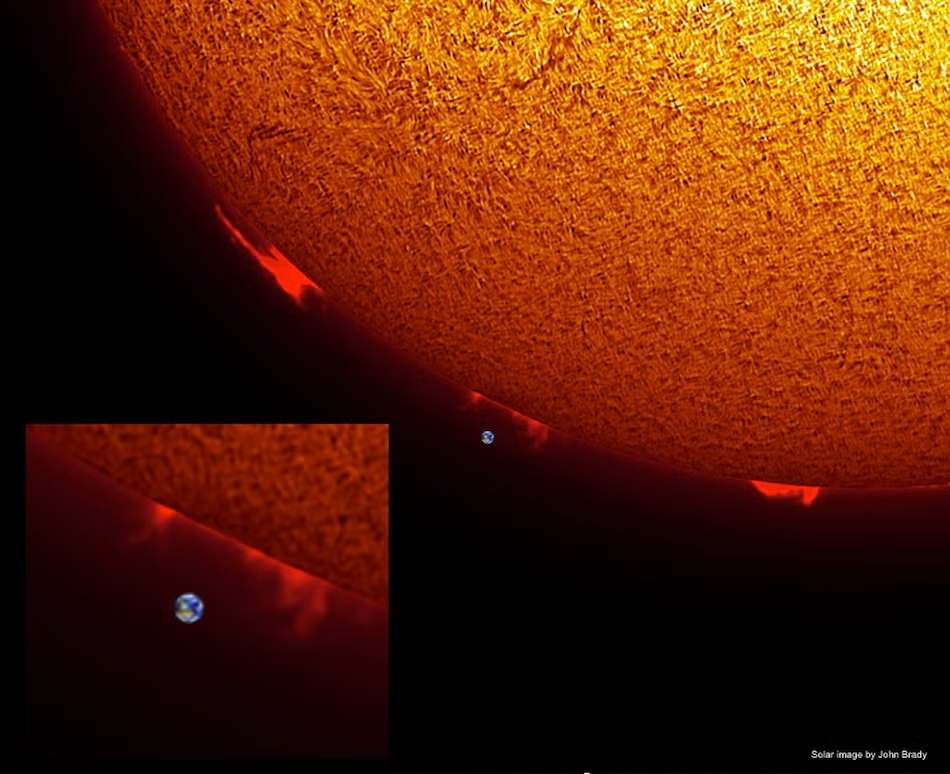
When you imagine Earth from far above, the first thing you notice is how quickly it becomes a tiny sphere in an enormous background. The further you picture yourself drifting from it, the more a quiet discomfort appears. That simple idea alone begins to show the unsettling nature of space: the distance, the emptiness, and the overwhelming scale that surrounds our planet.
It captures the feeling of impending terror that space creates. Its vast emptiness is more than lonely, it’s constricting. The size of space is difficult to imagine. Its sheer scale, a reminder of how small we really are.
It’s only when you compare Earth to other planets that you realise how fragile and small we are. Take Jupiter, a gas giant of endless storms. There is no surface, a probe would fall for days before being crushed and burned. The Great Red Spot, a storm at least 400 years old and wider than Earth, rips anything near it apart. Everything we know and love exists on Earth, yet a single storm on Jupiter puts our existence to shame. Saturn and Neptune show similar chaos, storms up to 1,000 mph that would tear muscle fibres off bone. And this is only one solar system. There are trillions of planets, each with their own forms of chaos.
But planets don’t compare to the truly colossal. Stars, luminous balls of hydrogen and helium, are millions of times bigger than Earth. Stars are the reason we are alive as humans, without our sun, we wouldn’t even be close to existing.
The numbers don’t really portray how big the Sun truly is. Saying it’s a million times bigger than Earth barely registers. A visual representation would be a better way to show the true scale of these things.
This is the Earth, comparable to the Sun. Again that is everything we know and love, one speck of matter compared to the Sun.
But what if I were to tell you that the Sun is unbelievably small, laughably small, so
tiny that it seems like an atom in the eyes of something even bigger? What I’m about to show you is an image of the Sun compared to one of the biggest known stars in the observable universe, UY Scuti.
UY Scuti is 325 million miles of nothing but a hot hydrogen and helium pool of convection and radiation. If you were to somehow construct a suit that would allow you to safely go deep into this massive star, you would most likely feel that at a certain point, the star itself is the new universe.
Yet even UY Scuti becomes insignificant when compared to objects like the biggest black hole; it isn’t even a speck of dust.
But size isn’t the only horror. Space is also unimaginably empty.
The distance between the Milky Way and the Andromeda Galaxy is 2.5 million light-years. Travelling between them means 2.5 million years of complete darkness, no pit stops, no planets, nothing but cold space. Even within a galaxy, the distances between stars are so immense that they feel like the closest thing to “nothing” we can imagine.
The reason this idea of pure vast nothingness is unsettling is that our brains struggle to comprehend it. We cannot handle the thought of essentially nothing in the vast dark spaces between celestial objects. The dark spaces between celestial objects and even galaxies are the closest thing you can get to nothing. The feeling of dread it gives is similar to the fear of the deep ocean and the massive unknown drop-off cliffs in the deep sea, however, space is much bigger, and the drop-offs never end, and it’s not so much unknown as it is lonely because the truth is space is horrifically lonely, every single part of it.
This emptiness becomes clearer when you look at structures like the Boötes Void, a region 330 million light-years across containing almost nothing. It represents about 2% of the observable universe, a single deep void of isolation.
Everything in space is separated by huge, unreachable distances, and the universe is expanding, making those distances grow. One day, galaxies will move away faster than we could ever reach them. Eventually, we will be isolated in our own galaxy, surrounded by an ever-growing darkness.
And then comes time, the most brutal scale of all.
Our universe is 13 billion years old. We were born in an era of active star formation. But unfortunately, it will likely never be this way again. According to heat death or also called slow death theory, the universe will continue to expand and as it expands, everything will continue to prosper.
Over time, however, and I mean a long time, all the raw materials needed to form stars will be used up or drift into cold, empty space, where new stars can’t form. Star formation will stop. The universe will enter a cold, dark era.
Over time, though slowly but surely, celestial objects begin to break down. Every star and planet has a limited existence. The universe starts to die down bit by bit.
But some objects will meet their demise much faster than others. You would think the biggest stars like supergiants would last the longest, but they live the shortest lives due to their intense gravity and unstable nature. They are likely to explode and go supernova or exhaust their energy at a very fast rate. They could even become black holes through the right conditions
Most celestial objects will decay relatively “soon” in cosmic time. But three objects will outlast the rest: black holes, white dwarfs, and black dwarfs.
Out of all of them, white dwarfs are easily taking last place here, and it’s not even close.
The true contest is between black holes and black dwarfs. Black holes are immensely powerful and intimidating, for good reason.
These ridiculous balls of mystery are so dense and heavy, that having them decay is nearly impossible. But as all things soon they too will decay. According to Hawking radiation, black holes decay but just very very slowly. Picture it like this, according to quantum physics there are two particles constantly popping in and out of existence on a normal basis, an anti-particle and a normal particle. If these particles were to pop in and out of existence right next to a black hole’s event horizon, theoretically, one of the particles can get sucked into the black hole whilst the other will perfectly and barely escape. This actually makes the black hole lose an ever so slightly minuscule amount of mass – so tiny that it will never be noticeable for trillions of years. So, they do decay and that’s important because no matter how long it takes their fate is all the same. The theoretical amount of time it would take for a black hole to decay under these rules is scary. The time would be roughly somewhere between 2 * 10^93 or a googol years. At this point in the universe, everything else would have decayed, galaxies would have dissipated, stars would have all died, everything would be gone and forgotten except these black holes that are silently buzzing towards the end of time.
Black dwarfs far outlast black holes, to the point that comparing the two almost feels absurd.
These dead stars emit almost no heat or light and decay so slowly that it’s nearly immeasurable. Theoretical models say they may survive for 10³²⁰⁰⁰ years, that is 32,000 zeros. When all else has vanished, the universe will be filled only with scattered black dwarfs drifting in darkness. Eventually, after incomprehens
As the last black dwarf explodes, theibly long periods of time, they too will die, possibly exploding in the final supernovae the universe will ever see. universe will finally fall silent.
The stars, the planets, the black holes are all gone.
The universe, after waiting billions of trillions of years, will reach its end.