
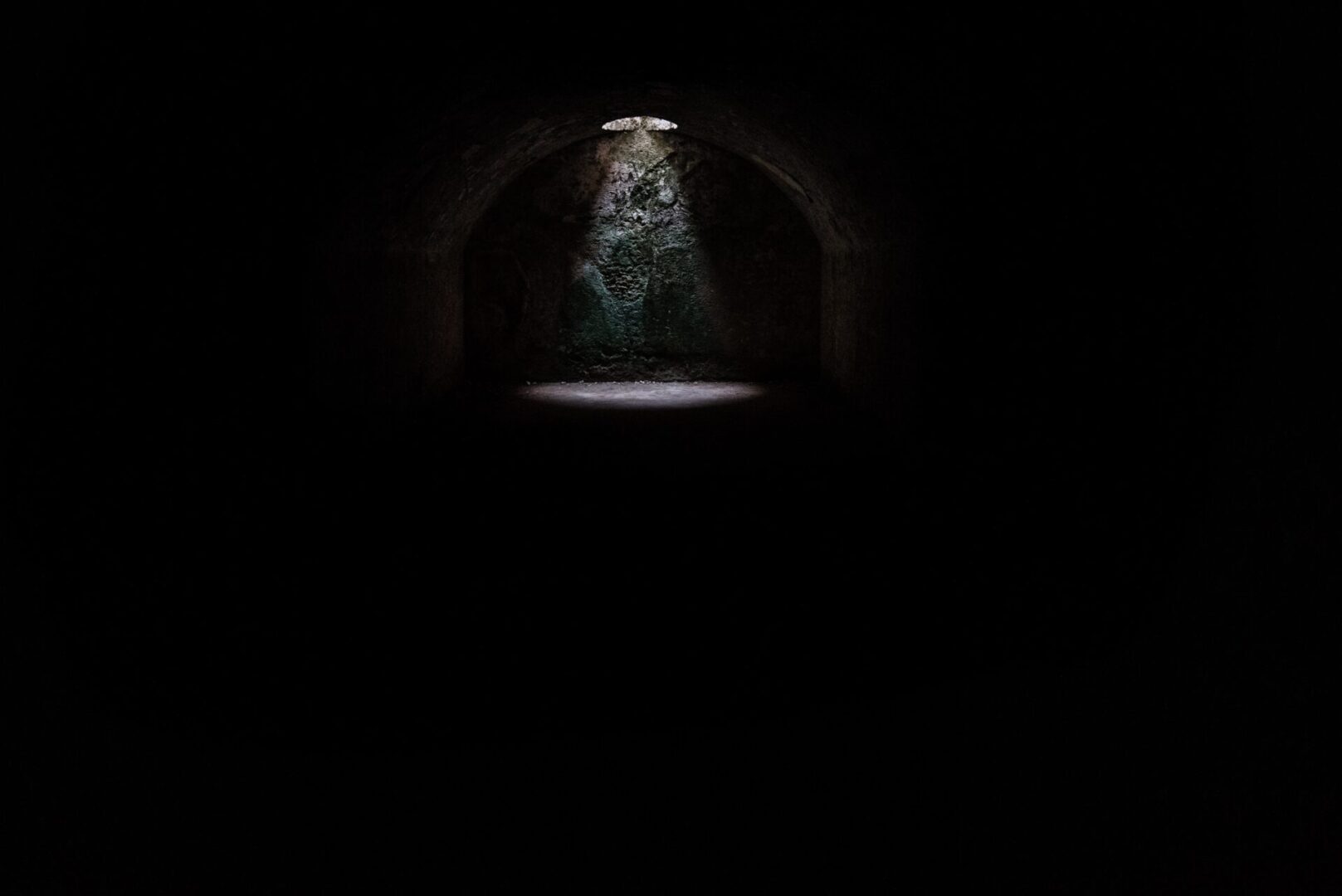
Our brains don’t want us to experience total darkness. I don’t mean this in a poetic, metaphorical way. I mean literally. There are very few places in nature where it’s even possible to blot out all illumination. Outside, even a moonless night can’t shut out the light of the stars. But say you’re determined, you could head underground. In a cave, you will find dark in the truest sense, a blackness unsullied by the least bit of natural light. Even then, alone in a cave, without the moon or your flashlight, your brain will fight against the dark.
Mere hours into total darkness, humans start to hallucinate. You don’t have to have a history of “seeing things.” Fully healthy, self-aware, otherwise lucid people will swiftly and dramatically start to hallucinate in true darkness. In 2004, researchers in Massachusetts blindfolded 13 participants for 96 straight hours. And yet, the participants “saw” many things, flashing lights, shapes, glowing trails, and even faces. All in the absence of any light at all.
In 2007, the German artist Marietta Schwartz blindfolded herself for over three weeks. Scientists monitored her over this period, during which she witnessed hallucinations as simple as leopard print and as complex as the opening credits to Star Trek. Scans of her brain indicated that she was not simply “imagining” these things but actually seeing them, the hallucinations activating the same visual processing centers of her mind that she would use to see the actual opening credits to Star Trek.
These experiences happened within controlled laboratory environments. But over the course of human history and art, many more people have confined themselves to a much more isolated form of darkness. In November of 2021, a woman named Beatriz Flamini descended into a cave in the south of Spain. She intended to remain underground and isolated longer than any human
in history. She almost did it. She specifically chose not to directly communicate with the outside world, no talking with others, no updates on current events. She would have a couple of battery-powered lights, but no clock or externally updated calendar. She would not see another human face for 500 days. Because she didn’t bring a mirror, she would not even see her own. She was, however, provided with a pair of GoPros, which she would use to record the whole experience.
Her fixation on dark and isolation, and disconnection, are unusual, but not entirely unique. The man she was attempting to take the record from was named Milutin Veljković. He was a Serbian scientist who spent 464 days in a row inside a cave. Veljković had a radio through which he could talk to people outside, but that communication did not spare him the effects of the dark. He hallucinates. His hair grows long and ragged. He pulls out his own teeth. Or there’s the French speleologist, Michel Siffre. In 1962, he ventured into a cave for two months straight. A decade later, he returned to the dark for another six. He found that his perception of time inevitably warped. Weeks after he entered the cave, he tried to mentally time two minutes, and it took him five. Occasionally, he stayed awake for 36 hours in a row, though he didn’t know it. When he was retrieved from the cave, he was surprised as to why they were pulling him out, since in his mind, he was only halfway through. When Flamini emerged from the cave in 2023, after a year and a half of residence, she seemed thrilled with her time. She told writer D.T. Max that her stay was “excellent,” “unbeatable.” She took a series of medical exams, and all her vitals were normal. Her attitude seemed almost unbelievable. But the GoPros tell another story.
The first thing they document is her loss of time. By day 38, she was already losing her sense of time. Then the auditory phantoms enter the picture. She begins to hear things, “This
is not paranoia, this is not hallucinations,” she whispers to her GoPros. “If it’s an animal, it’s a big animal.” She was always alone in the cave. To enter, one had to rappel down a 200-foot sheer drop. But she was convinced there was something there with her. 300 days in, Flamini breaks. She blames the route that researchers had placed in the cave, says that it’s sending out sonic waves that are giving her nosebleeds. She climbs out of the cave, but stays confined to her tent at the entrance. Assistants replace the router. She goes back in. And the more she talks about the dark, the more her initial report, “Excellent! Unbeatable!” seems like an attempt to rationalize, maybe even repress, her true experience.
Because of Flamini’s brief leave from the cave, she fails her record attempt. Veljković’s 464-day stay in the 60s still bests her. But I wonder how much the record matters to her now, how much importance she puts on the exact amount of time she spent in the dark. The cameras, the other scientists, they monitored how long she was down there. But Flamini experienced something different. Michel Siffre was more blunt about his time in isolation, in what he called “the terrifying sensation of infinite space.” He wrote: “I now understand why in their myths, people have always situated Hell underground.” And this is the language of the people most eager to explore the dark.
Here’s an obnoxious question for you: Can you see the dark? Well? Is water wet? Imagine a room without illumination, the door is open, but no light can make it past the threshold. Are we “seeing” darkness in that room, or would it be more accurately described as an absence of perception? Semantical explanations can’t contend with lizard-brain fear instincts. But “can you see the dark” is a revealing question, because it breaks down all the abstract language we so often use to talk about it into a single, base anxiety. Here is how I would describe the fear of the dark, once you suck all the poeticism out of it: either there is nothing there, or there is something there. That’s it. That’s all there is. Either the dark conceals something, or the dark reveals nothing.
There is a unique menace that a room can hold in the dark, particularly when suddenly
awoken in it. The ordinary turned uneasy, familiar corners now posing a single, dreadful question: Is there nothing there? Or is there something there? It’s the same reason a dark hallway makes your nerves stand up, the empty space feels like it could hold anything.
The darkness of the sky is measured on something called the “Bortle scale.” It goes from 1-9, and the higher the scale, the more light pollution and the fewer stars you can see. Kuwait and most major cities sit around 8–9, where light pollution erases almost all stars. But travel far into the desert, and you can reach Bortle 2 or 3, where the Milky Way becomes visible. Yet even there, distant light still leaves a faint glow on the horizon. To really achieve the true darkness, the only option might be to go out to sea. 500 km away from the coast, where the lights from towns and cities eventually drop out of sight. To sail out there on a moonless night and turn off all the lights of the boat might give you true darkness, not the darkness of the caves, but that of the vast emptiness of space.
There’s a fact about light pollution that’s always stuck with me, though. Most kinds of pollution stick around, even if you completely stopped all air or water pollution tomorrow, we’d still be dealing with its current leftovers for millennia. But not light. You turn off all the lights, and the skies return to their primeval darkness at literally the speed that light travels away from Earth. We would, instantly, be thrown back to the same skies seen by the earliest of our species. The dark is never really that far away.
Probably because, without darkness, there is no us. Darkness is not just an absence of light, it makes us who we are. REM sleep depends on it, without it, the body and mind cannot fully recover, and the ability to imagine, dream, and think is diminished. As the French philosopher, Descartes says, “I think, therefore I am.” Even though we primitively fear the dark, we cannot live without it.
All of us, willingly or not, confront the dark every day. It is the bedrock of the universe,
an absolute inevitability, a required element of life and death and rest and time. And yet,
we refuse to simply perceive the dark; rather than sit within total absence, our brains spin
illusions out into the void. After all, how could there truly be nothing there?
The fear of the unknowable reaches of our oceans and the depths of the earth are all merely an extension of the dark. That black, that abyss, that place we cannot see is not merely a fear, it is the fear. From it, all other fears, thoughts, and life emerge.